Life in the Joseon Dynasty: Traditional Korean Travel and Hanbok Culture
[한국어]
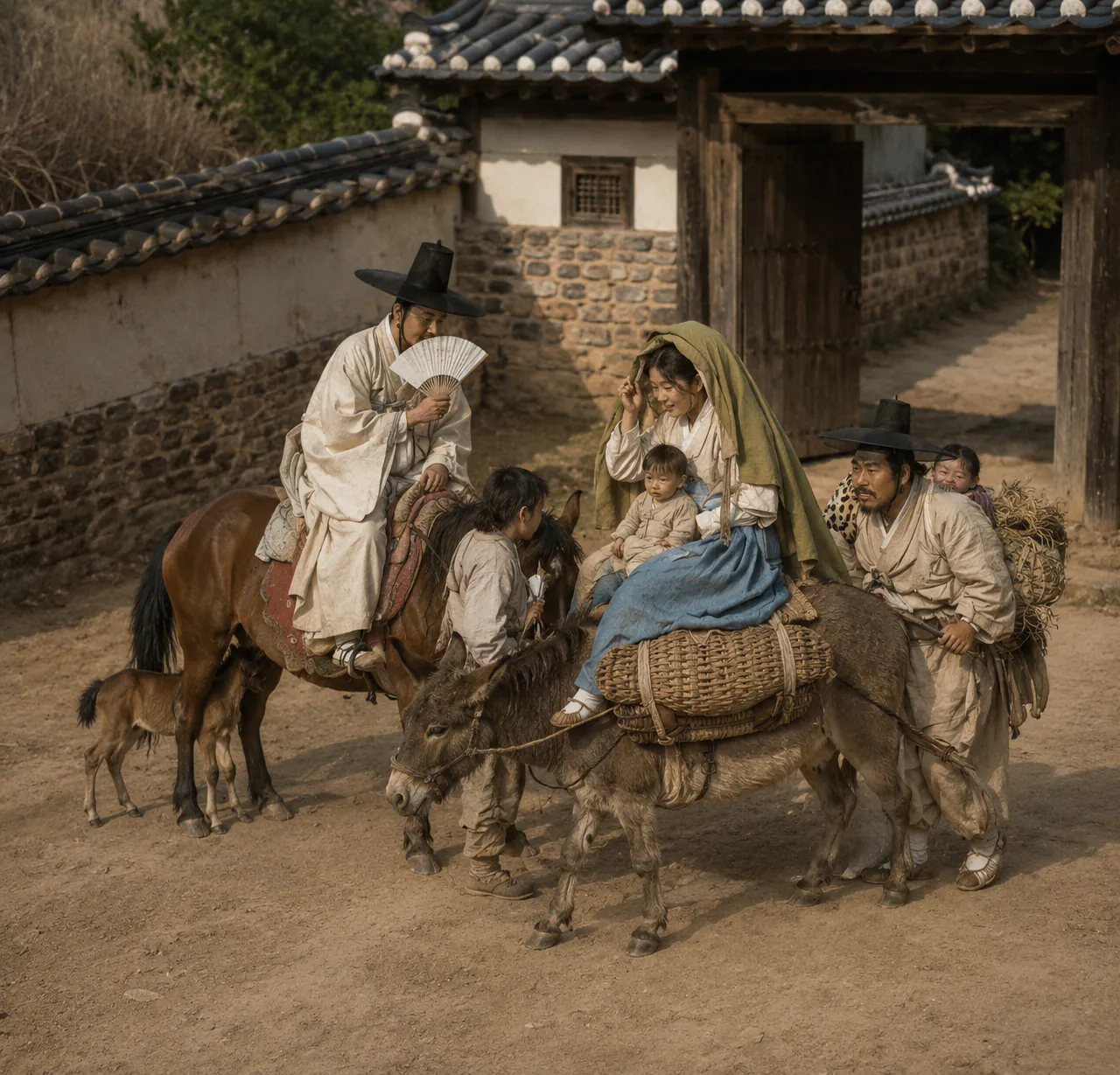
사진으로 보는 조선 시대의 여행길: 양반, 서민, 그리고 전통 한복의 조화
이 사진은 한국의 마지막 왕조인 '조선 시대(1392~1910)' 사람들의 이동하는 풍경을 생생하게 묘사하고 있습니다. 한 장의 사진 속에 한국의 전통 의상인 한복과 당시의 엄격했던 신분 제도, 그리고 생활상이 고스란히 담겨 있습니다. 한국 역사와 사극 드라마에 관심 있는 분들을 위해 사진 속 숨겨진 문화적 코드들을 알기 쉽게 설명해 드립니다.
1. 높은 신분의 상징: 말을 탄 '양반'과 '갓'
사진 왼쪽, 커다란 말을 타고 있는 남성은 조선 시대의 귀족 계급인 **'양반(Yangban)'**입니다.
갓(Gat): 머리에 쓴 검은색 둥근 모자는 넷플릭스 드라마 '킹덤(Kingdom)'을 통해 외국인들에게도 친숙해진 '갓'입니다. 이는 성인 남성이자 양반의 품위를 나타냅니다.
흰색 두루마기와 부채: 깨끗하고 품이 넓은 흰색 한복 외투(두루마기)를 입고 한 손에 부채를 든 모습은 육체 노동을 하지 않는 지배 계층의 여유로움과 높은 사회적 지위를 보여줍니다.
2. 조선 시대 여성의 외출: 당나귀와 '쓰개치마'
중앙에 당나귀를 타고 있는 여성과 아이의 모습도 매우 흥미롭습니다.
얼굴을 가리는 천: 여성은 머리에 초록색 천을 덮어쓰고 있습니다. 조선 시대 여성들은 유교 문화의 영향으로 외출할 때 자신의 얼굴을 외부에 함부로 보여주지 않기 위해 **'쓰개치마(Ssugaechima)'**나 장옷이라는 외투를 머리에 썼습니다.
이동 수단: 당시 신분이 높은 여성들이라도 큰 말보다는 가마를 타거나, 사진처럼 짐을 싣는 용도로도 쓰이는 당나귀를 이용하는 경우가 많았습니다. 당나귀 양옆에 달린 짚으로 엮은 바구니는 당시의 전통적인 수납 도구입니다.
3. 길을 걷는 사람들: '평민'과 짚신
당나귀를 끌고 걷는 남성과 아이는 평민 계층이거나 양반을 모시는 하인(노비)들입니다.
말을 탄 양반과 대비되게 이들은 걷고 있으며, 옷차림 역시 흙먼지가 묻어도 괜찮은 수수한 색상의 활동하기 편한 한복을 입고 있습니다.
발에는 가죽신이 아닌 볏짚으로 엮어 만든 서민들의 신발, **'짚신(Jipsin)'**을 신고 있습니다. 이렇게 타는 동물과 입는 옷, 걷는 위치만으로도 조선 시대의 계급 사회를 명확하게 알 수 있습니다.
4. 한국의 전통 건축: '돌담'과 '기와지붕'
배경에 보이는 건축물은 한국 전통 마을의 고즈넉한 분위기를 자아냅니다.
자연스러운 흙과 돌을 섞어 쌓아 올린 담장은 **'돌담(Doldam)'**이라고 부릅니다.
뒤쪽 문 위에 얹어진 검은색 지붕은 흙을 구워 만든 **'기와(Giwa)'**입니다. 기와지붕은 주로 부유한 집안이나 관공서 등에서 사용된 고급 건축 양식입니다.
이 사진은 한국의 전통적인 아름다움뿐만 아니라, 과거 사람들의 계층별 삶의 방식을 한눈에 이해할 수 있는 훌륭한 장면입니다. 한국의 사극(Historical K-Dramas)을 시청할 때 이러한 복장과 이동 수단의 차이를 유심히 살펴본다면, 한국 문화를 훨씬 더 깊이 있고 재미있게 즐기실 수 있을 것입니다.
[English]
A Journey During the Joseon Dynasty Through a Photograph: The Harmony of Yangban, Commoners, and Traditional Hanbok
This photograph vividly depicts a traveling scene of people from Korea's last dynasty, the 'Joseon Dynasty (1392–1910)'. Captured in this single photo are the traditional Korean clothing, Hanbok, the strict class system of the time, and daily lifestyle. For those interested in Korean history and historical dramas, we explain the hidden cultural codes within the photo in an easy-to-understand way.
1. Symbol of High Status: The 'Yangban' on a Horse and the 'Gat'
The man on the large horse on the left side of the photo is a 'Yangban', a member of the aristocratic class of the Joseon Dynasty.
Gat: The black, round hat on his head is the 'Gat', which has become familiar to foreigners through the Netflix drama Kingdom. It represents the dignity of an adult male and a Yangban.
White Durumagi and Fan: Wearing a clean, wide-fitting white Hanbok overcoat (Durumagi) and holding a fan in one hand shows the leisure and high social status of the ruling class, who did not engage in manual labor.
2. A Joseon Woman's Outing: Donkey and 'Ssugaechima'
The sight of the woman and child riding a donkey in the center is also very interesting.
Face-covering Cloth: The woman is covering her head with a green cloth. Influenced by Confucian culture, women of the Joseon Dynasty wore an overcoat called 'Ssugaechima' or Jangot over their heads when going out, so as not to casually reveal their faces to the outside world.
Means of Transportation: Even high-status women of the time often used palanquins or donkeys, which were also used for carrying goods as seen in the photo, rather than large horses. The straw-woven baskets hanging on both sides of the donkey are traditional storage items of the time.
3. People Walking on the Road: 'Commoners' and Straw Shoes
The man and child walking and leading the donkey are commoners or servants (slaves) serving the Yangban.
In contrast to the Yangban on horseback, they are walking, and their clothing is also practical Hanbok in modest colors that are fine even if they get covered in dirt.
On their feet, they wear 'Jipsin', shoes for commoners woven from rice straw, rather than leather shoes. Just by the animals they ride, the clothes they wear, and their walking positions, the hierarchical society of the Joseon Dynasty is clearly evident.
4. Traditional Korean Architecture: 'Doldam' and 'Giwa' Roofs
The architecture seen in the background creates the serene atmosphere of a traditional Korean village.
The wall, built by naturally mixing earth and stones, is called 'Doldam'.
The black roof sitting on top of the gate in the back is made of 'Giwa' (roof tiles), which are made from baked clay. Giwa roofs were a high-end architectural style mainly used by wealthy families or government offices.
This photograph is an excellent scene that allows you to grasp at a glance not only the traditional beauty of Korea but also the lifestyles of people in the past by social class. If you pay close attention to these differences in clothing and transportation when watching Historical K-Dramas, you will be able to enjoy Korean culture much more deeply and entertainingly.
[Español]
Un viaje en la dinastía Joseon a través de la fotografía: la armonía entre Yangban, plebeyos y el Hanbok tradicional
Esta fotografía describe vívidamente una escena de viaje de las personas de la última dinastía de Corea, la 'Dinastía Joseon (1392-1910)'. En una sola foto se capturan la vestimenta tradicional coreana (Hanbok), el estricto sistema de clases de la época y el estilo de vida cotidiano. Para aquellos interesados en la historia de Corea y los dramas históricos, explicamos los códigos culturales ocultos en la foto de una manera fácil de entender.
1. Símbolo de alto estatus: el 'Yangban' a caballo y el 'Gat'
El hombre montado en el gran caballo a la izquierda de la foto es un 'Yangban', miembro de la clase aristocrática de la dinastía Joseon.
Gat: El sombrero negro y redondo en su cabeza es el 'Gat', que se ha vuelto familiar para los extranjeros a través del drama de Netflix Kingdom. Representa la dignidad de un hombre adulto y de un Yangban.
Durumagi blanco y abanico: Llevar un abrigo Hanbok blanco, limpio y holgado (Durumagi), y sostener un abanico en una mano muestra el ocio y el alto estatus social de la clase dominante, que no realizaba trabajos manuales.
2. La salida de una mujer de Joseon: el burro y la 'Ssugaechima'
La imagen de la mujer y el niño montados en un burro en el centro también es muy interesante.
Tela para cubrir el rostro: La mujer se cubre la cabeza con una tela verde. Influenciadas por la cultura confuciana, las mujeres de la dinastía Joseon usaban un abrigo llamado 'Ssugaechima' o Jangot sobre sus cabezas al salir, para no revelar su rostro al mundo exterior a la ligera.
Medios de transporte: Incluso las mujeres de alto estatus de la época a menudo usaban palanquines o burros, que también se usaban para transportar mercancías como se ve en la foto, en lugar de caballos grandes. Las cestas tejidas con paja que cuelgan a ambos lados del burro son artículos de almacenamiento tradicionales de la época.
3. Personas caminando por el camino: 'Plebeyos' y zapatos de paja
El hombre y el niño que caminan y guían al burro son plebeyos o sirvientes (esclavos) que sirven al Yangban.
En contraste con el Yangban a caballo, ellos caminan y su vestimenta es un Hanbok práctico de colores modestos, adecuado aunque se ensucie de tierra.
En sus pies, no llevan zapatos de cuero, sino 'Jipsin', zapatos para plebeyos tejidos con paja de arroz. Solo por los animales que montan, la ropa que usan y su posición al caminar, la sociedad jerárquica de la dinastía Joseon resulta claramente evidente.
4. Arquitectura tradicional coreana: 'Doldam' y techos de 'Giwa'
La arquitectura que se ve en el fondo crea el ambiente sereno de un pueblo tradicional coreano.
El muro, construido mezclando tierra y piedras de forma natural, se llama 'Doldam'.
El techo negro que se encuentra sobre la puerta en la parte trasera está hecho de 'Giwa' (tejas), que están hechas de arcilla cocida. Los techos de Giwa eran un estilo arquitectónico de alta gama utilizado principalmente por familias adineradas u oficinas gubernamentales.
Esta fotografía es una escena excelente que permite comprender de un vistazo no solo la belleza tradicional de Corea, sino también los estilos de vida de las personas del pasado según su clase social. Si presta mucha atención a estas diferencias en la ropa y el transporte al ver dramas históricos coreanos (K-Dramas), podrá disfrutar de la cultura coreana de una manera mucho más profunda y entretenida.
[Français]
Un voyage sous la dynastie Joseon à travers la photographie : l'harmonie entre Yangban, roturiers et Hanbok traditionnel
Cette photographie décrit de manière vivante une scène de voyage des habitants de la dernière dynastie coréenne, la « dynastie Joseon (1392-1910) ». Une seule photo capture les vêtements traditionnels coréens (Hanbok), le système de classes strict de l'époque et le mode de vie quotidien. Pour ceux qui s'intéressent à l'histoire coréenne et aux drames historiques, nous expliquons les codes culturels cachés dans la photo d'une manière facile à comprendre.
1. Symbole de statut social élevé : le « Yangban » à cheval et le « Gat »
L'homme sur le grand cheval sur le côté gauche de la photo est un « Yangban », un membre de la classe aristocratique de la dynastie Joseon.
Gat : Le chapeau noir et rond sur sa tête est le « Gat », qui est devenu familier aux étrangers grâce au drame Netflix Kingdom. Il représente la dignité d'un homme adulte et d'un Yangban.
Durumagi blanc et éventail : Porter un pardessus Hanbok blanc, propre et ample (Durumagi), et tenir un éventail d'une main montre le loisir et le statut social élevé de la classe dirigeante, qui ne se livrait pas au travail manuel.
2. La sortie d'une femme de Joseon : l'âne et la « Ssugaechima »
La vue de la femme et de l'enfant chevauchant un âne au centre est également très intéressante.
Tissu couvrant le visage : La femme se couvre la tête avec un tissu vert. Influencées par la culture confucéenne, les femmes de la dynastie Joseon portaient un pardessus appelé « Ssugaechima » ou Jangot sur la tête lorsqu'elles sortaient, afin de ne pas révéler leur visage au monde extérieur à la légère.
Moyens de transport : Même les femmes de haut rang de l'époque utilisaient souvent des palanquins ou des ânes, qui servaient également au transport de marchandises comme on le voit sur la photo, plutôt que de grands chevaux. Les paniers tressés en paille suspendus des deux côtés de l'âne sont des articles de rangement traditionnels de l'époque.
3. Les gens marchant sur la route : les « roturiers » et les chaussures en paille
L'homme et l'enfant qui marchent et guident l'âne sont des roturiers ou des serviteurs (esclaves) au service du Yangban.
Contrairement au Yangban à cheval, ils marchent, et leurs vêtements sont également des Hanbok pratiques de couleurs modestes, qui conviennent même s'ils sont couverts de saleté.
Aux pieds, ils portent des « Jipsin », des chaussures pour roturiers tressées en paille de riz, plutôt que des chaussures en cuir. Rien que par les animaux qu'ils montent, les vêtements qu'ils portent et leurs positions de marche, la société hiérarchique de la dynastie Joseon est clairement évidente.
4. Architecture traditionnelle coréenne : les toits en « Doldam » et « Giwa »
L'architecture visible en arrière-plan crée l'atmosphère sereine d'un village coréen traditionnel.
Le mur, construit en mélangeant naturellement de la terre et des pierres, est appelé « Doldam ».
Le toit noir posé sur la porte à l'arrière est composé de « Giwa » (tuiles), qui sont faites d'argile cuite. Les toits en Giwa étaient un style architectural haut de gamme principalement utilisé par les familles riches ou les bureaux du gouvernement.
Cette photographie est une excellente scène qui vous permet de saisir d'un coup d'œil non seulement la beauté traditionnelle de la Corée, mais aussi les modes de vie des gens du passé selon leur classe sociale. Si vous prêtez une attention particulière à ces différences vestimentaires et de transport lorsque vous regardez des drames historiques coréens (K-Dramas), vous pourrez apprécier la culture coréenne de manière beaucoup plus profonde et divertissante.
[Deutsch]
Eine Reise in der Joseon-Dynastie durch die Fotografie: Die Harmonie von Yangban, Bürgerlichen und traditionellem Hanbok
Diese Fotografie schildert anschaulich eine Reiseszene von Menschen aus Koreas letzter Dynastie, der „Joseon-Dynastie (1392–1910)“. In einem einzigen Foto sind die traditionelle koreanische Kleidung, der Hanbok, das strenge Klassensystem der damaligen Zeit und der Alltag festgehalten. Für diejenigen, die sich für koreanische Geschichte und historische Dramen interessieren, erklären wir die im Foto verborgenen kulturellen Codes auf leicht verständliche Weise.
1. Symbol für hohen Status: Der „Yangban“ auf einem Pferd und der „Gat“
Der Mann auf dem großen Pferd auf der linken Seite des Fotos ist ein „Yangban“, ein Mitglied der aristokratischen Klasse der Joseon-Dynastie.
Gat: Der schwarze, runde Hut auf seinem Kopf ist der „Gat“, der Ausländern durch das Netflix-Drama Kingdom vertraut geworden ist. Er repräsentiert die Würde eines erwachsenen Mannes und eines Yangban.
Weißer Durumagi und Fächer: Das Tragen eines sauberen, weit geschnittenen weißen Hanbok-Mantels (Durumagi) und das Halten eines Fächers in einer Hand zeigen die Freizeit und den hohen sozialen Status der herrschenden Klasse, die keine körperliche Arbeit verrichtete.
2. Der Ausflug einer Joseon-Frau: Esel und „Ssugaechima“
Der Anblick der Frau und des Kindes, die in der Mitte auf einem Esel reiten, ist ebenfalls sehr interessant.
Gesichtsverhüllendes Tuch: Die Frau bedeckt ihren Kopf mit einem grünen Tuch. Beeinflusst von der konfuzianischen Kultur trugen Frauen der Joseon-Dynastie beim Ausgehen einen Mantel namens „Ssugaechima“ oder Jangot über dem Kopf, um der Außenwelt ihre Gesichter nicht leichtfertig zu zeigen.
Transportmittel: Selbst Frauen mit hohem Status nutzten damals oft Sänften oder Esel, die, wie auf dem Foto zu sehen ist, auch zum Transport von Gütern verwendet wurden, anstelle von großen Pferden. Die an beiden Seiten des Esels hängenden, aus Stroh geflochtenen Körbe sind traditionelle Aufbewahrungsgegenstände der damaligen Zeit.
3. Menschen, die auf der Straße gehen: „Bürgerliche“ und Strohschuhe
Der Mann und das Kind, die gehen und den Esel führen, sind Bürgerliche oder Diener (Sklaven), die dem Yangban dienen.
Im Gegensatz zum Yangban zu Pferd gehen sie zu Fuß, und ihre Kleidung ist ebenfalls ein praktischer Hanbok in bescheidenen Farben, dem es nichts ausmacht, wenn er mit Schmutz bedeckt ist.
An den Füßen tragen sie anstelle von Lederschuhen „Jipsin“, Schuhe für Bürgerliche, die aus Reisstroh geflochten sind. Allein durch die Tiere, auf denen sie reiten, die Kleidung, die sie tragen, und ihre Gehpositionen wird die hierarchische Gesellschaft der Joseon-Dynastie deutlich sichtbar.
4. Traditionelle koreanische Architektur: „Doldam“- und „Giwa“-Dächer
Die im Hintergrund zu sehende Architektur schafft die ruhige Atmosphäre eines traditionellen koreanischen Dorfes.
Die Mauer, die durch natürliches Mischen von Erde und Steinen gebaut wurde, wird „Doldam“ genannt.
Das schwarze Dach, das auf dem Tor im Hintergrund sitzt, besteht aus „Giwa“ (Dachziegeln), die aus gebranntem Ton hergestellt werden. Giwa-Dächer waren ein hochwertiger Architekturstil, der hauptsächlich von wohlhabenden Familien oder Regierungsbüros verwendet wurde.
Diese Fotografie ist eine hervorragende Szene, die es Ihnen ermöglicht, nicht nur die traditionelle Schönheit Koreas, sondern auch die Lebensweise der Menschen in der Vergangenheit nach sozialer Klasse auf einen Blick zu erfassen. Wenn Sie beim Ansehen historischer K-Dramen genau auf diese Unterschiede in Kleidung und Transportmitteln achten, werden Sie die koreanische Kultur viel tiefgreifender und unterhaltsamer genießen können.
Share output