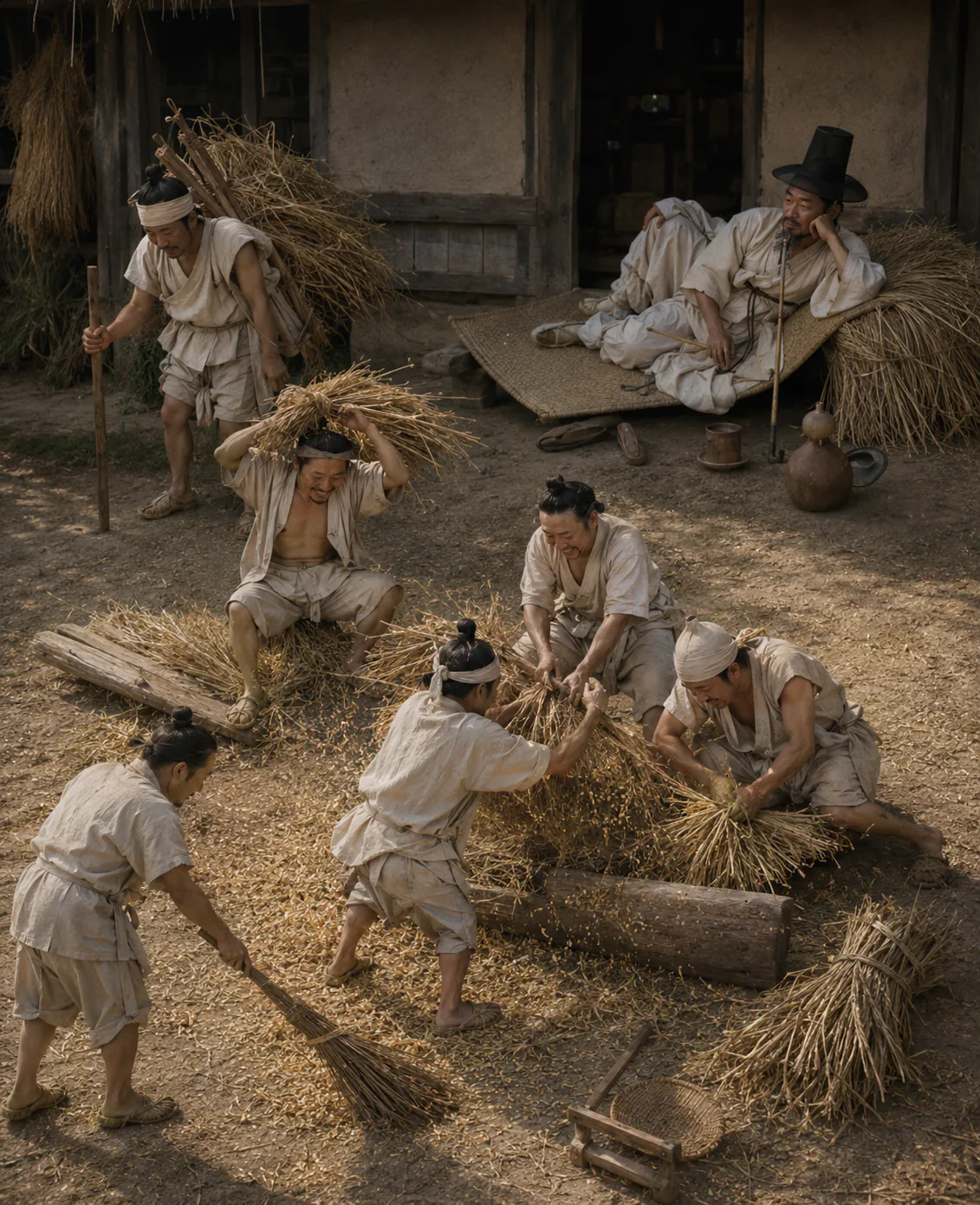
Traditional Daily Life in the Joseon Dynasty: Peasants Threshing Grain Scene
[한국어]
조선 시대 엿보기: 한국의 전통 농업과 사회 계급
이 이미지는 한국 조선 시대(1392~1910)의 전통적인 가을 추수 풍경을 생생하게 포착하고 있습니다. 한국 역사에 관심이 있는 사람이라면 이것이 단순한 농사 그림이 아니라 전통적인 한국 사회, 농업, 그리고 과거의 엄격한 신분 제도를 완벽하게 보여주는 장면이라는 것을 알 수 있습니다. 다음은 한국 문화의 관점에서 여러분이 보고 있는 것을 이해하기 쉽게 분석한 것입니다:
1. 한국 농업의 핵심: 벼 타작
중앙과 전경에는 열심히 일하는 농부들이 보입니다. 그들은 타작이라는 전통적인 농업 작업을 하고 있습니다. 마른 벼나 보리 단을 두꺼운 통나무에 내리쳐서 줄기에서 식용 곡물을 분리해냅니다. 왼쪽 아래의 또 다른 농부는 떨어진 곡물을 전통 짚빗자루로 쓸고 있습니다. 쌀은 전통적인 한국 경제와 식생활의 절대적인 중심이었기 때문에, 추수기는 일 년 중 가장 바쁘고 힘든 시기였습니다.
2. 평민(상민): 전통 의상과 머리 모양
일하고 있는 남자들을 자세히 보세요. 그들은 상민으로 알려진 평민 계층을 대표합니다.
의상: 그들은 단순하고 염색하지 않은 면이나 삼베 옷을 입고 있습니다. 평민들은 역사적으로 이런 평범한 흰옷을 입었기 때문에, 한국인들은 역사적으로 "백의민족"으로 불렸습니다.
머리 모양: 그들의 머리가 정수리에 단단한 매듭으로 묶여 있는 것을 보셨나요? 이것을 상투라고 부릅니다. 조선 시대에는 머리카락을 자르는 것이 부모에게 불효하는 것으로 여겨졌습니다. 남자는 결혼하면 긴 머리를 이 상투로 틀어 올려 성인으로서의 지위를 상징했습니다.
3. 귀족(양반): 엄격한 사회 계급을 보여주는 그림
이 이미지에서 가장 눈에 띄는 대조는 오른쪽 위 모서리에서 여유롭게 쉬고 있는 남자입니다. 농부들이 땀과 먼지로 뒤덮여 있는 동안, 그는 짚자리에 편안하게 앉아 긴 전통 담뱃대(곰방대)를 피우고 있습니다.
검은 모자: 그는 전통적인 한국의 검은 말총 모자인 갓을 쓰고 있습니다. 갓은 양반(귀족 및 관료 계층)의 엄격한 상징이었습니다.
대조: 이 장면은 조선 시대의 엄격한 사회 계급을 완벽하게 보여줍니다. 양반은 대개 땅을 소유하고 시와 정치를 공부하는 데 집중한 반면, 평민들은 세금과 소작료를 내기 위해 등골이 휘는 육체노동을 했습니다.
한국 역사의 살아있는 캔버스
이 단일한 장면을 통해 한국 농경 문화의 깊은 뿌리를 쉽게 이해할 수 있습니다. 이 그림은 나라를 세운 고된 노동과 전통적인 한국 사회를 형성한 역사적인 계급 차이 간의 대조를 아름다우면서도 사실적으로 묘사하고 있습니다.
[English]
A Glimpse into the Joseon Dynasty: Traditional Korean Agriculture and Social Hierarchy
This image vividly captures a traditional autumn harvest scene from Korea's Joseon Dynasty (1392–1910). For anyone interested in Korean history, this is not just a picture of farming; it’s a perfect snapshot of traditional Korean society, agriculture, and the strict class system of the past.
Here is an easy-to-understand breakdown of what you are seeing from a Korean cultural perspective:
1. The Heart of Korean Agriculture: Rice Threshing
In the center and foreground, you see farmers hard at work. They are performing a traditional agricultural task called threshing. By beating the dried rice or barley sheaves against a thick wooden log, they separate the edible grains from the stalks. Another farmer at the bottom left is sweeping the fallen grains with a traditional straw broom. Because rice was the absolute center of the traditional Korean economy and diet, harvest time was the busiest and most exhausting time of the year.
2. The Commoners (Sangmin): Traditional Dress and Hair
Look closely at the working men. They represent the commoner class, known as Sangmin.
The Clothing: They are wearing simple, undyed cotton or hemp clothing. Because commoners historically wore these plain white clothes, Koreans were historically referred to as the "White-Clad Race" (Baeguiminjok).
The Hairstyle: Notice how their hair is tied up into a tight knot on top of their heads? This is called a Sangtu. In the Joseon era, cutting one's hair was considered disrespectful to one's parents. Once a man got married, he would tie his long hair into this topknot, symbolizing his status as an adult.
3. The Aristocrat (Yangban): A Picture of Strict Social Hierarchy
The most striking contrast in this image is the man lounging in the top right corner. While the farmers are covered in sweat and dust, he is comfortably resting on a woven mat, smoking a long traditional pipe (Gombangdae).
The Black Hat: He is wearing a Gat, a traditional Korean black horsehair hat. The Gat was a strict symbol of the Yangban (the aristocratic and scholar-official class).
The Contrast: This scene perfectly illustrates the rigid social hierarchy of the Joseon Dynasty. The Yangban typically owned the land and focused on studying poetry and politics, while the commoners did the back-breaking physical labor to pay taxes and rent.
A Living Canvas of Korean History
Through this single scene, you can easily understand the deep roots of Korea's agrarian culture. It beautifully yet realistically portrays the contrast between the grueling labor that built the country and the historical class divisions that shaped traditional Korean society.
[Español]
Un vistazo a la dinastía Joseon: Agricultura tradicional coreana y jerarquía social
Esta imagen captura vívidamente una escena tradicional de cosecha otoñal de la dinastía Joseon de Corea (1392-1910). Para cualquiera interesado en la historia de Corea, esto no es solo una imagen de agricultura; es una instantánea perfecta de la sociedad coreana tradicional, la agricultura y el estricto sistema de clases del pasado.
Aquí hay un desglose fácil de entender de lo que está viendo desde una perspectiva cultural coreana:
1. El corazón de la agricultura coreana: Trilla de arroz
En el centro y en primer plano, se ven agricultores trabajando duro. Están realizando una tarea agrícola tradicional llamada trilla. Al golpear las gavillas de arroz o cebada seca contra un grueso tronco de madera, separan los granos comestibles de los tallos. Otro agricultor en la parte inferior izquierda está barriendo los granos caídos con una escoba de paja tradicional. Dado que el arroz era el centro absoluto de la economía y la dieta tradicionales coreanas, la época de cosecha era la más ocupada y agotadora del año.
2. Los plebeyos (Sangmin): Vestimenta y peinado tradicionales
Mire de cerca a los hombres que trabajan. Representan a la clase plebeya, conocida como Sangmin.
La ropa: Llevan ropa sencilla de algodón o cáñamo sin teñir. Debido a que los plebeyos históricamente vestían esta ropa blanca y lisa, los coreanos fueron históricamente referidos como la "Raza vestida de blanco" (Baeguiminjok).
El peinado: ¿Nota cómo su cabello está atado en un nudo apretado en la parte superior de sus cabezas? Esto se llama Sangtu. En la era Joseon, cortarse el pelo se consideraba una falta de respeto hacia los padres. Una vez que un hombre se casaba, se ataba su largo cabello en este moño, simbolizando su estatus como adulto.
3. El aristócrata (Yangban): Una imagen de la estricta jerarquía social
El contraste más llamativo en esta imagen es el hombre que descansa en la esquina superior derecha. Mientras los agricultores están cubiertos de sudor y polvo, él descansa cómodamente sobre una estera tejida, fumando una larga pipa tradicional (Gombangdae).
El sombrero negro: Lleva un Gat, un sombrero tradicional coreano de pelo de caballo negro. El Gat era un símbolo estricto del Yangban (la clase aristocrática y de eruditos-oficiales).
El contraste: Esta escena ilustra perfectamente la rígida jerarquía social de la dinastía Joseon. Los Yangban normalmente poseían la tierra y se centraban en estudiar poesía y política, mientras que los plebeyos hacían el trabajo físico agotador para pagar impuestos y rentas.
Un lienzo vivo de la historia coreana
A través de esta única escena, puede comprender fácilmente las profundas raíces de la cultura agraria de Corea. Retrata de manera hermosa pero realista el contraste entre el trabajo agotador que construyó el país y las divisiones históricas de clase que dieron forma a la sociedad tradicional coreana.
[Français]
Un aperçu de la dynastie Joseon : Agriculture traditionnelle coréenne et hiérarchie sociale
Cette image capture de manière saisissante une scène traditionnelle de récolte automnale de la dynastie Joseon en Corée (1392–1910). Pour quiconque s'intéresse à l'histoire coréenne, ce n'est pas seulement une image d'agriculture ; c'est un cliché parfait de la société coréenne traditionnelle, de l'agriculture et du strict système de classes du passé.
Voici une analyse facile à comprendre de ce que vous voyez d'un point de vue culturel coréen :
1. Le cœur de l'agriculture coréenne : Le battage du riz
Au centre et au premier plan, vous voyez des agriculteurs travaillant dur. Ils effectuent une tâche agricole traditionnelle appelée le battage. En frappant les gerbes de riz ou d'orge séchées contre un épais rondin de bois, ils séparent les grains comestibles des tiges. Un autre agriculteur en bas à gauche balaie les grains tombés avec un balai de paille traditionnel. Parce que le riz était le centre absolu de l'économie et du régime alimentaire traditionnels coréens, la période des récoltes était la période la plus occupée et la plus épuisante de l'année.
2. Les roturiers (Sangmin) : Tenue et coiffure traditionnelles
Regardez de près les hommes au travail. Ils représentent la classe des roturiers, connue sous le nom de Sangmin.
Les vêtements : Ils portent des vêtements simples en coton ou en chanvre non teints. Parce que les roturiers portaient historiquement ces vêtements blancs unis, les Coréens étaient historiquement appelés le « Peuple vêtu de blanc » (Baeguiminjok).
La coiffure : Remarquez-vous comment leurs cheveux sont attachés en un nœud serré sur le dessus de leur tête ? C'est ce qu'on appelle un Sangtu. À l'époque Joseon, se couper les cheveux était considéré comme un manque de respect envers ses parents. Une fois qu'un homme se mariait, il attachait ses longs cheveux en ce chignon, symbolisant son statut d'adulte.
3. L'aristocrate (Yangban) : Une image de la stricte hiérarchie sociale
Le contraste le plus frappant dans cette image est l'homme qui se prélasse dans le coin supérieur droit. Alors que les agriculteurs sont couverts de sueur et de poussière, il se repose confortablement sur une natte tissée, fumant une longue pipe traditionnelle (Gombangdae).
Le chapeau noir : Il porte un Gat, un chapeau traditionnel coréen en crin de cheval noir. Le Gat était un symbole strict du Yangban (la classe aristocratique et des lettrés-fonctionnaires).
Le contraste : Cette scène illustre parfaitement la hiérarchie sociale rigide de la dynastie Joseon. Les Yangban possédaient généralement les terres et se concentraient sur l'étude de la poésie et de la politique, tandis que les roturiers effectuaient un travail physique éreintant pour payer des impôts et des loyers.
Une toile vivante de l'histoire coréenne
À travers cette seule scène, vous pouvez facilement comprendre les racines profondes de la culture agraire coréenne. Elle dépeint de manière à la fois belle et réaliste le contraste entre le travail exténuant qui a construit le pays et les divisions historiques des classes qui ont façonné la société traditionnelle coréenne.
[Deutsch]
Ein Blick in die Joseon-Dynastie: Traditionelle koreanische Landwirtschaft und soziale Hierarchie
Dieses Bild fängt auf lebendige Weise eine traditionelle herbstliche Ernteszene aus der koreanischen Joseon-Dynastie (1392–1910) ein. Für jeden, der sich für die koreanische Geschichte interessiert, ist dies nicht nur ein Bild der Landwirtschaft; es ist eine perfekte Momentaufnahme der traditionellen koreanischen Gesellschaft, der Landwirtschaft und des strengen Klassensystems der Vergangenheit.
Hier ist eine leicht verständliche Aufschlüsselung dessen, was Sie aus einer koreanischen kulturellen Perspektive sehen:
1. Das Herzstück der koreanischen Landwirtschaft: Reisdreschen
In der Mitte und im Vordergrund sehen Sie Bauern bei der harten Arbeit. Sie führen eine traditionelle landwirtschaftliche Aufgabe namens Dreschen aus. Indem sie die getrockneten Reis- oder Gerstengarben gegen einen dicken Holzklotz schlagen, trennen sie die essbaren Körner von den Halmen. Ein weiterer Bauer unten links fegt die heruntergefallenen Körner mit einem traditionellen Strohbesen zusammen. Da Reis das absolute Zentrum der traditionellen koreanischen Wirtschaft und Ernährung war, war die Erntezeit die geschäftigste und anstrengendste Zeit des Jahres.
2. Das einfache Volk (Sangmin): Traditionelle Kleidung und Haartracht
Schauen Sie sich die arbeitenden Männer genau an. Sie repräsentieren die Klasse des einfachen Volkes, bekannt als Sangmin.
Die Kleidung: Sie tragen einfache, ungefärbte Baumwoll- oder Hanfkleidung. Da das einfache Volk historisch gesehen diese schlichte weiße Kleidung trug, wurden die Koreaner in der Geschichte als das „weiß gekleidete Volk“ (Baeguiminjok) bezeichnet.
Die Haartracht: Fällt Ihnen auf, wie ihre Haare zu einem festen Knoten auf dem Kopf zusammengebunden sind? Dies wird Sangtu genannt. In der Joseon-Ära galt das Haareschneiden als respektlos gegenüber den Eltern. Sobald ein Mann heiratete, band er sein langes Haar zu diesem Haarknoten zusammen, der seinen Status als Erwachsener symbolisierte.
3. Der Aristokrat (Yangban): Ein Bild strenger sozialer Hierarchie
Der auffälligste Kontrast in diesem Bild ist der Mann, der in der oberen rechten Ecke faulenzt. Während die Bauern mit Schweiß und Staub bedeckt sind, ruht er sich bequem auf einer geflochtenen Matte aus und raucht eine lange traditionelle Pfeife (Gombangdae).
Der schwarze Hut: Er trägt einen Gat, einen traditionellen koreanischen schwarzen Hut aus Pferdehaar. Der Gat war ein strenges Symbol der Yangban (der aristokratischen und Gelehrten-Beamten-Klasse).
Der Kontrast: Diese Szene veranschaulicht perfekt die starre soziale Hierarchie der Joseon-Dynastie. Die Yangban besaßen in der Regel das Land und konzentrierten sich auf das Studium von Poesie und Politik, während das einfache Volk die rückenbrecherische körperliche Arbeit verrichtete, um Steuern und Pacht zu zahlen.
Eine lebendige Leinwand der koreanischen Geschichte
Durch diese einzige Szene können Sie leicht die tiefen Wurzeln der koreanischen Agrarkultur verstehen. Sie porträtiert auf schöne und zugleich realistische Weise den Kontrast zwischen der zermürbenden Arbeit, die das Land aufgebaut hat, und den historischen Klassenunterschieden, die die traditionelle koreanische Gesellschaft geprägt haben.