Traditional Korean Archery: History, Techniques, and Gungdo Culture
[한국어]
조선시대 무예의 숨결: 한국 전통 활쏘기(국궁)와 한복의 조화
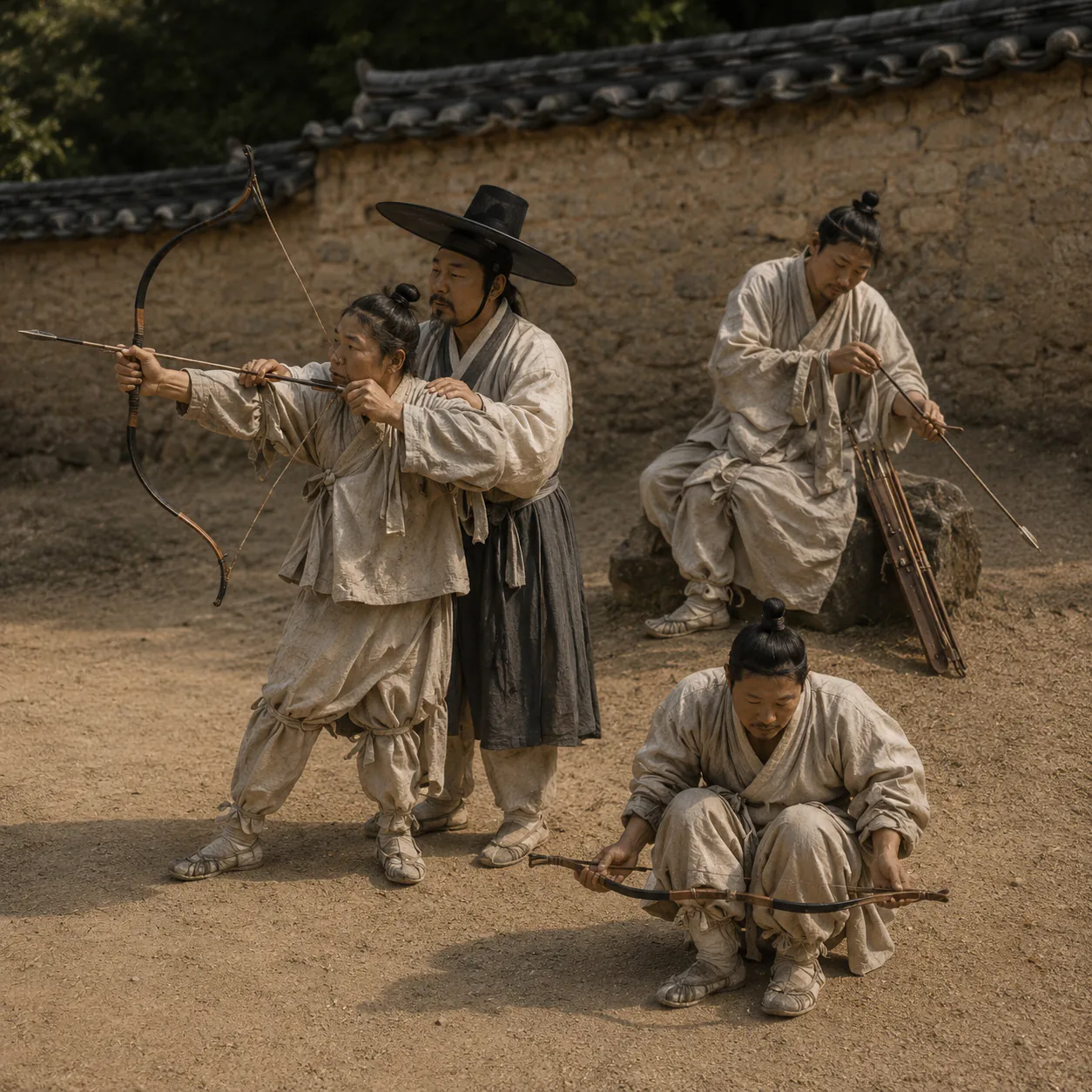
이 사진은 마치 조선시대(1392~1910)를 배경으로 한 사극 영화의 한 장면처럼, 한국의 전통 활쏘기를 훈련하는 생생한 모습을 담고 있습니다. 한국 역사와 문화에 관심 있는 분들을 위해 이 사진 속 숨겨진 한국적인 요소들을 알기 쉽게 설명해 드립니다.
1. 정신을 수련하는 무예, 국궁 (Korean Traditional Archery, Gungdo)
사진 왼쪽을 보면 검은 모자를 쓴 스승이 활을 쥐고 있는 사람의 자세를 세밀하게 교정해 주고 있습니다. 한국의 전통 활은 크기가 작아 보이지만, 엄청난 탄력과 파괴력을 자랑합니다. 과거 한국의 선비(학자)들에게 활쏘기는 단순한 전투 기술이 아니라, 호흡을 가다듬고 마음을 집중하는 '정신 수련'의 필수 과정이었습니다. 오른쪽과 아래에 앉아 활과 화살을 점검하는 사람들의 모습에서 무예를 대하는 진지한 태도를 엿볼 수 있습니다.
2. 활동성을 강조한 평상복 한복 (Everyday Hanbok)
사진 속 인물들은 왕족이나 귀족의 화려한 비단옷이 아닌, 거친 질감의 무채색 한복을 입고 있습니다. 이는 무술 훈련이나 일상생활을 할 때 입었던 실용적인 옷입니다. 특히 바지 밑단을 보면 발목을 천 끈(대님)으로 단단히 묶었는데, 이는 흙먼지를 막고 활동하기 편하게 만드는 한국 전통 바지의 특징입니다.
3. 세계가 주목한 모자, 갓 (Gat)
스승 역할을 하는 인물이 머리에 쓰고 있는 검은색 챙이 넓은 모자는 **'갓(Gat)'**이라고 부릅니다. 넷플릭스 인기 드라마 '킹덤(Kingdom)'을 통해 전 세계적으로 유명해진 이 모자는, 대나무와 말총을 엮어 만들었으며 조선시대 성인 남성의 품격과 신분을 나타내는 중요한 아이템이었습니다.
4. 성인 남성의 상징, 상투 (Sangtu)
모자를 쓰지 않은 두 남성의 머리를 보면, 정수리 위로 머리카락을 둥글게 틀어 올린 것을 볼 수 있습니다. 이 헤어스타일을 **'상투'**라고 합니다. 과거 한국에서는 남자가 결혼을 하여 어른이 되면 반드시 머리를 길러 상투를 틀었으며, 부모님이 물려주신 머리카락을 자르지 않는 것을 중요한 효도(예의)로 여겼습니다.
5. 자연과 어우러진 전통 담장 (Traditional Wall)
인물들 뒤로 보이는 배경은 흙과 돌을 섞어 쌓고, 그 위에 비를 막기 위해 기와를 얹은 한국의 전통 담장입니다. 화려하지 않지만 주변의 흙바닥, 나무와 자연스럽게 어우러지는 한국 특유의 소박한 미학을 보여줍니다.
이 사진은 한국의 역동적인 무예 문화와 조선시대 사람들의 일상적인 복식을 시각적으로 완벽하게 재현해 내어, 한국 전통문화의 매력을 느끼기에 매우 훌륭한 작품입니다.
검색 최적화(SEO) 추천 키워드:
#KoreanTraditionalArchery #Gungdo #Hanbok #Gat #Sangtu #JoseonDynasty #KoreanCulture #한국전통활쏘기 #국궁 #조선시대한복 #갓 #한국문화 #사극배경
[English]
The Breath of Martial Arts in the Joseon Dynasty: The Harmony of Korean Traditional Archery (Gungdo) and Hanbok
This photo looks like a scene from a historical movie set in the Joseon Dynasty (1392–1910), capturing a vivid moment of people practicing Korean traditional archery. For those interested in Korean history and culture, we explain the hidden Korean elements in this photo in an easy-to-understand way.
1. A Martial Art for Mental Discipline, Gungdo (Korean Traditional Archery)
Looking at the left side of the photo, a master wearing a black hat is meticulously correcting the posture of the person holding the bow. Traditional Korean bows may look small, but they boast immense elasticity and destructive power. To the Seonbi (scholars) of the past, archery was not merely a combat skill, but an essential process of "mental discipline" to control one's breathing and focus the mind. The serious attitude towards martial arts can be seen in the individuals sitting on the right and at the bottom, inspecting their bows and arrows.
2. Everyday Hanbok Emphasizing Mobility (Everyday Hanbok)
The figures in the photo are not wearing the splendid silk garments of royalty or nobility, but rather practical, rough-textured, achromatic Hanbok worn during martial arts training or daily life. In particular, if you look at the bottom of the pants, their ankles are tied tightly with cloth straps (daenim). This is a unique characteristic of traditional Korean pants that prevents dirt from entering and makes movement much easier.
3. The Hat That Caught the World's Attention, Gat
The wide-brimmed black hat worn by the figure acting as the master is called a "Gat." Made famous globally through the hit Netflix drama "Kingdom," this hat is woven from bamboo and horsehair. It was a vital item representing the dignity and social status of adult men in the Joseon Dynasty.
4. The Symbol of Adult Men, Sangtu
If you look at the heads of the two men without hats, you can see their hair tied up in a round knot on the top of their heads. This hairstyle is called "Sangtu." In the past, when a Korean man married and became an adult, he was required to grow his hair out and tie it into a sangtu. Preserving the hair inherited from one's parents without cutting it was considered a crucial act of filial piety (respect).
5. Traditional Wall Blending with Nature (Traditional Wall)
The background behind the figures is a traditional Korean wall built by mixing earth and stones, topped with roof tiles to block the rain. Though it is not flashy, it showcases Korea's unique, modest aesthetic that harmonizes naturally with the surrounding dirt ground and trees.
This photo perfectly recreates the dynamic martial arts culture of Korea and the everyday attire of the Joseon Dynasty people, making it an excellent visual piece to experience the charm of traditional Korean culture.
SEO Recommended Keywords:
#KoreanTraditionalArchery #Gungdo #Hanbok #Gat #Sangtu #JoseonDynasty #KoreanCulture #한국전통활쏘기 #국궁 #조선시대한복 #갓 #한국문화 #사극배경
[Español]
El aliento de las artes marciales en la Dinastía Joseon: La armonía del tiro con arco tradicional coreano (Gungdo) y el Hanbok
Esta foto parece una escena de una película histórica ambientada en la dinastía Joseon (1392-1910), capturando un momento vívido de la práctica del tiro con arco tradicional coreano. Para aquellos interesados en la historia y la cultura de Corea, explicamos de manera sencilla los elementos coreanos ocultos en esta imagen.
1. Un arte marcial para la disciplina mental, Gungdo (Tiro con arco tradicional coreano)
Observando el lado izquierdo de la foto, un maestro que lleva un sombrero negro corrige minuciosamente la postura de la persona que sostiene el arco. Los arcos tradicionales coreanos pueden parecer pequeños, pero cuentan con una inmensa elasticidad y poder destructivo. Para los Seonbi (eruditos) del pasado, el tiro con arco no era solo una técnica de combate, sino un proceso esencial de "disciplina mental" para controlar la respiración y concentrar la mente. La actitud seria hacia las artes marciales se puede apreciar en las personas sentadas a la derecha y abajo, que inspeccionan sus arcos y flechas.
2. Hanbok de uso diario que enfatiza la movilidad (Hanbok cotidiano)
Las figuras en la foto no llevan las espléndidas ropas de seda de la realeza o la nobleza, sino un Hanbok práctico, de textura áspera y colores acromáticos, usado durante el entrenamiento de artes marciales o en la vida diaria. En particular, si nos fijamos en el dobladillo de los pantalones, los tobillos están fuertemente atados con cintas de tela (daenim). Esta es una característica de los pantalones tradicionales coreanos que evita la entrada de polvo y facilita el movimiento.
3. El sombrero que llamó la atención del mundo, Gat
El sombrero negro de ala ancha que lleva la figura que actúa como maestro se llama "Gat". Hecho mundialmente famoso a través del exitoso drama de Netflix "Kingdom", este sombrero está tejido con bambú y crin de caballo, y era un artículo importante que representaba la dignidad y el estatus social de los hombres adultos en la dinastía Joseon.
4. El símbolo de los hombres adultos, Sangtu
Al observar las cabezas de los dos hombres que no llevan sombrero, se puede ver que su cabello está recogido en un moño redondo en la parte superior de la cabeza. Este peinado se llama "Sangtu". Antiguamente en Corea, cuando un hombre se casaba y se convertía en adulto, debía dejarse crecer el cabello y atarlo en un sangtu. No cortarse el cabello heredado de los padres se consideraba un importante acto de piedad filial (respeto).
5. Muro tradicional que se funde con la naturaleza (Muro tradicional)
El fondo detrás de las figuras es un muro tradicional coreano construido mezclando tierra y piedras, coronado con tejas para bloquear la lluvia. Aunque no es llamativo, muestra una estética coreana modesta y única que se integra de forma natural con el suelo de tierra y los árboles circundantes.
Esta foto recrea visualmente a la perfección la dinámica cultura de las artes marciales de Corea y la vestimenta cotidiana de la gente de la dinastía Joseon, convirtiéndola en una obra excelente para sentir el encanto de la cultura tradicional coreana.
Palabras clave recomendadas para SEO:
#KoreanTraditionalArchery #Gungdo #Hanbok #Gat #Sangtu #JoseonDynasty #KoreanCulture #한국전통활쏘기 #국궁 #조선시대한복 #갓 #한국문화 #사극배경
[Français]
Le souffle des arts martiaux sous la dynastie Joseon : L'harmonie du tir à l'arc traditionnel coréen (Gungdo) et du Hanbok
Cette photo ressemble à une scène d'un film historique se déroulant sous la dynastie Joseon (1392-1910), capturant un moment vivant de la pratique du tir à l'arc traditionnel coréen. Pour ceux qui s'intéressent à l'histoire et à la culture coréennes, nous expliquons de manière simple les éléments coréens cachés dans cette image.
1. Un art martial pour la discipline mentale, Gungdo (Tir à l'arc traditionnel coréen)
En regardant le côté gauche de la photo, un maître portant un chapeau noir corrige minutieusement la posture de la personne tenant l'arc. Les arcs traditionnels coréens peuvent paraître petits, mais ils possèdent une élasticité et une puissance destructrice immenses. Pour les Seonbi (érudits) du passé, le tir à l'arc n'était pas seulement une technique de combat, mais un processus essentiel de "discipline mentale" pour contrôler sa respiration et concentrer son esprit. L'attitude sérieuse envers les arts martiaux est visible chez les personnes assises à droite et en bas, inspectant leurs arcs et leurs flèches.
2. Un Hanbok de tous les jours privilégiant la mobilité (Hanbok quotidien)
Les personnages sur la photo ne portent pas les splendides vêtements en soie de la royauté ou de la noblesse, mais un Hanbok pratique, à la texture rugueuse et aux couleurs achromatiques, porté lors des entraînements aux arts martiaux ou dans la vie quotidienne. En particulier, si l'on regarde le bas des pantalons, les chevilles sont fermement attachées avec des lanières en tissu (daenim). Il s'agit d'une caractéristique des pantalons traditionnels coréens qui empêche la poussière d'entrer et facilite les mouvements.
3. Le chapeau qui a attiré l'attention du monde, Gat
Le chapeau noir à larges bords porté par le personnage agissant en tant que maître s'appelle un "Gat". Rendu célèbre dans le monde entier grâce à la série à succès de Netflix "Kingdom", ce chapeau est tissé à partir de bambou et de crin de cheval, et constituait un élément important représentant la dignité et le statut social des hommes adultes sous la dynastie Joseon.
4. Le symbole des hommes adultes, Sangtu
En regardant la tête des deux hommes qui ne portent pas de chapeau, on peut voir leurs cheveux noués en un chignon rond sur le dessus de leur tête. Cette coiffure s'appelle "Sangtu". Autrefois en Corée, lorsqu'un homme se mariait et devenait adulte, il devait se laisser pousser les cheveux et les attacher en un sangtu. Ne pas couper les cheveux hérités de ses parents était considéré comme un acte important de piété filiale (respect).
5. Un mur traditionnel en harmonie avec la nature (Mur traditionnel)
L'arrière-plan derrière les personnages est un mur traditionnel coréen construit en mélangeant de la terre et des pierres, surmonté de tuiles pour bloquer la pluie. Bien qu'il ne soit pas voyant, il met en valeur une esthétique coréenne modeste et unique qui se fond naturellement avec le sol en terre et les arbres environnants.
Cette photo recrée visuellement à la perfection la culture dynamique des arts martiaux de Corée et la tenue vestimentaire quotidienne des habitants de la dynastie Joseon, ce qui en fait une excellente œuvre pour ressentir le charme de la culture traditionnelle coréenne.
Mots-clés recommandés pour le référencement (SEO) :
#KoreanTraditionalArchery #Gungdo #Hanbok #Gat #Sangtu #JoseonDynasty #KoreanCulture #한국전통활쏘기 #국궁 #조선시대한복 #갓 #한국문화 #사극배경
[Deutsch]
Der Hauch der Kampfkunst in der Joseon-Dynastie: Die Harmonie von traditionellem koreanischem Bogenschießen (Gungdo) und Hanbok
Dieses Foto wirkt wie eine Szene aus einem historischen Film, der in der Joseon-Dynastie (1392-1910) spielt, und fängt einen lebendigen Moment des Trainings im traditionellen koreanischen Bogenschießen ein. Für alle, die sich für die koreanische Geschichte und Kultur interessieren, erklären wir die versteckten koreanischen Elemente in diesem Foto auf leicht verständliche Weise.
1. Eine Kampfkunst zur mentalen Disziplin, Gungdo (Traditionelles koreanisches Bogenschießen)
Auf der linken Seite des Fotos sieht man einen Meister mit einem schwarzen Hut, der die Haltung der Person, die den Bogen hält, sorgfältig korrigiert. Koreanische traditionelle Bögen mögen klein aussehen, besitzen aber eine immense Elastizität und Zerstörungskraft. Für die Seonbi (Gelehrten) der Vergangenheit war das Bogenschießen nicht nur eine Kampftechnik, sondern ein wesentlicher Prozess der „mentalen Disziplin“, um die Atmung zu kontrollieren und den Geist zu fokussieren. Die ernsthafte Einstellung zur Kampfkunst zeigt sich auch an den Personen, die rechts und unten sitzen und ihre Bögen und Pfeile überprüfen.
2. Alltags-Hanbok mit Fokus auf Beweglichkeit (Alltags-Hanbok)
Die Personen auf dem Foto tragen keine prächtigen Seidenkleider der Könige oder Adligen, sondern einen praktischen, grob strukturierten und unbunten Hanbok, der beim Kampfsporttraining oder im Alltag getragen wurde. Besonders am unteren Rand der Hosen ist zu erkennen, dass die Knöchel fest mit Stoffbändern (Daenim) zusammengebunden sind – ein Merkmal traditioneller koreanischer Hosen, das vor Schmutz und Staub schützt und die Bewegungsfreiheit deutlich erhöht.
3. Der Hut, der die Aufmerksamkeit der Welt erregte, Gat
Der breitkrempige schwarze Hut, den die Person trägt, die als Meister fungiert, wird „Gat“ genannt. Weltweit bekannt geworden durch die erfolgreiche Netflix-Serie „Kingdom“, wird dieser Hut aus Bambus und Pferdehaar geflochten und war ein wichtiges Symbol für die Würde und den gesellschaftlichen Status erwachsener Männer in der Joseon-Dynastie.
4. Das Symbol des erwachsenen Mannes, Sangtu
Wenn man die Köpfe der beiden Männer ohne Hut betrachtet, sieht man, dass ihre Haare zu einem runden Knoten auf dem Kopf zusammengebunden sind. Diese Frisur wird „Sangtu“ genannt. In der Vergangenheit musste ein Mann in Korea, wenn er heiratete und erwachsen wurde, sein Haar wachsen lassen und zu einem Sangtu binden. Das Haar, das man von seinen Eltern geerbt hatte, nicht zu schneiden, galt als ein wichtiger Akt der kindlichen Pietät (Respekt).
5. Traditionelle Mauer im Einklang mit der Natur (Traditionelle Mauer)
Der Hintergrund hinter den Figuren ist eine traditionelle koreanische Mauer, die aus einer Mischung von Erde und Steinen erbaut und mit Dachziegeln abgedeckt wurde, um den Regen abzuhalten. Obwohl sie nicht auffällig ist, zeigt sie eine einzigartige, bescheidene koreanische Ästhetik, die sich natürlich in den umliegenden Erdboden und die Bäume einfügt.
Dieses Foto stellt die dynamische Kampfkunstkultur Koreas und die Alltagskleidung der Menschen in der Joseon-Dynastie visuell perfekt dar und ist somit ein hervorragendes Werk, um den Charme der traditionellen koreanischen Kultur zu spüren.